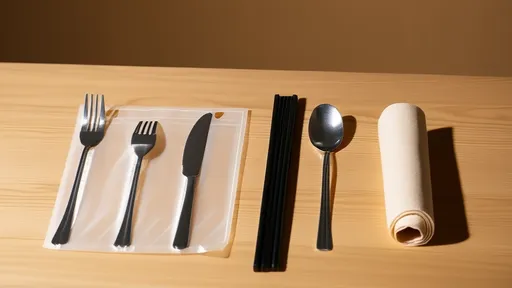
In the quiet moments before a meal arrives at our doorstep, there exists a ritual so commonplace it often escapes our attention—the unwrapping of individually packaged cutlery. This seemingly insignificant act, repeated millions of times daily across the globe, is far more than a prelude to dining; it is a microcosm of modern consumer culture, environmental ethics, and personal convenience clashing in the palm of one’s hand.
The first contact is usually auditory—the distinct crinkle of plastic or the soft tear of paper. For many, this sound is synonymous with anticipation, the signal that a meal is moments away from being enjoyed. The packaging, whether a slim plastic sleeve, a paper envelope, or a more elaborate kit complete with napkin, straw, and condiments, is designed for one thing: hygiene. In a post-pandemic world, the assurance of cleanliness has become paramount. Restaurants and delivery platforms justify this individual wrapping as a necessary barrier, a guarantee to the customer that their utensils have not been touched by another human hand since being sterilized and sealed. This promise of safety, however, comes wrapped in a paradox.
Beneath the surface of this convenience lies an environmental ledger that is deeply in the red. The majority of these single-use packages are made from plastics derived from fossil fuels—materials designed to last for centuries, used for mere seconds before being discarded. Even paper-based packaging, often perceived as the greener alternative, carries a hidden cost: the energy, water, and chemicals expended in its production, frequently lined with thin plastic films to prevent grease from seeping through, rendering it non-recyclable in most municipal systems. The individual wrapping of a single fork becomes a symbol of a linear economy—take, make, dispose—on a devastatingly miniature scale.
The act of unwrapping is also a moment of decision, however unconscious. Most consumers, hungry and focused on their meal, do not pause to consider the lifecycle of the plastic sheath they’ve just torn open. It is an accepted, almost invisible part of the transaction. Yet, for a growing minority, that same crinkle is a note of dissonance. It is a trigger for climate anxiety, a small but persistent reminder of the immense waste generated by the convenience economy. This divide in consumer consciousness is where the battle for sustainable practices is quietly being fought.
Industry response has been a mix of innovation and hesitation. Some forward-thinking restaurants and apps now offer an "opt-out" option for cutlery altogether, a simple checkbox that places the burden of choice on the customer. Others are experimenting with biodegradable materials made from cornstarch or bamboo, though these solutions are not without their own complications. True biodegradability often requires specific industrial composting conditions that are unavailable to most consumers, meaning these "eco-friendly" packages frequently end up in the same landfills as their conventional counterparts, failing to break down as intended. The search for a perfect, scalable solution remains elusive.
Furthermore, the independent wrapping of cutlery speaks to a broader cultural shift towards hyper-individualization. We live in an era of personalized meals, customized delivery instructions, and products tailored to individual tastes. The individually wrapped utensil is the physical manifestation of this trend—a tool designated for one person, alone. It reinforces a mindset of singularity over community, of personal convenience over collective resource sharing. In contrast, a traditional household operates with a drawer of shared cutlery, washed and reused. The delivery model disrupts this norm, outsourcing the cleaning and providing a sterile, personal set for every single meal, every single time.
The future of this tiny yet significant piece of packaging is uncertain. Legislative pressures are mounting in various cities and countries to ban single-use plastics outright, which would force the industry to adapt rapidly. Technological advancements might eventually provide a truly sustainable material that is cheap, effective, and widely compostable. However, the most profound change may need to be cultural. It requires a reevaluation of what we consider necessary for convenience and a collective willingness to embrace slightly less convenience for a far greater environmental good. Perhaps the solution is not a better wrapper, but fewer wrappers altogether.
In the end, the simple act of tearing open a package of cutlery is a gesture loaded with meaning. It is a connection point between a hungry individual and a vast global system of production, distribution, and waste. Each tear is a vote, a silent endorsement of the practices behind the meal. As we become more aware of the consequences of these micro-actions, the hope is that the sound of that crinkle will not be one of thoughtless consumption, but a conscious step towards a more considered and sustainable way of living, one meal at a time.

By /Aug 26, 2025

By /Aug 26, 2025

By /Aug 26, 2025

By /Aug 26, 2025

By /Aug 26, 2025

By /Aug 26, 2025

By /Aug 26, 2025

By /Aug 26, 2025

By /Aug 26, 2025

By /Aug 26, 2025
By /Aug 26, 2025

By /Aug 26, 2025

By /Aug 26, 2025

By /Aug 26, 2025

By /Aug 26, 2025

By /Aug 26, 2025

By /Aug 26, 2025
By /Aug 26, 2025

By /Aug 26, 2025

By /Aug 26, 2025